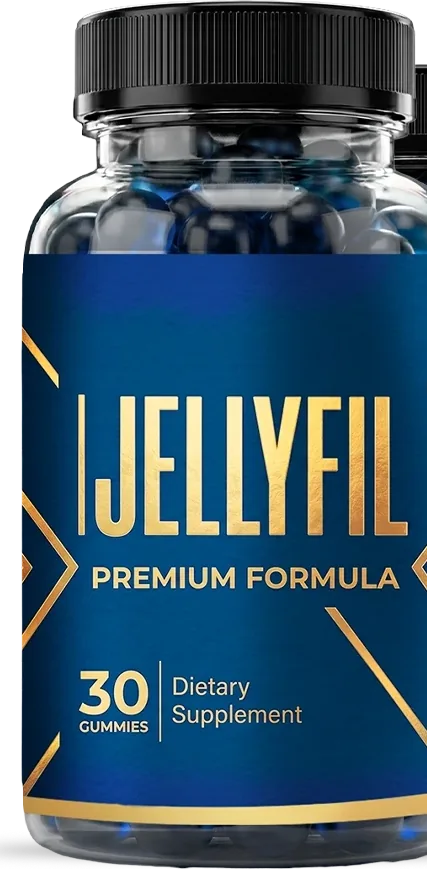
Reading the panel
What 82 mg Buys You Inside a Jellyfil Gummy
The printed panel gives a proprietary blend of 82 mg shared by nine ingredients, with only the caffeine broken out at 5 mg, and a footnote calling the blend equivalent to approximately 567 mg of dry powders. The same panel gives 3 g of added sugar, which is 3,000 mg. The blend total is a ceiling on every ingredient in it, not a dose of any of them.

What does 82 mg actually buy you?
Nine ingredients, sharing one weight, with no figure published for eight of them. That is the honest answer, and it comes entirely from the printed panel rather than from anyone's opinion.
The panel gives the blend as Proprietary Blend 82 mg, followed by nine names in a row underneath, then a footnote saying the blend is equivalent to approximately 567 mg of dry powders. One of those nine, caffeine, is broken out at 5 mg. The other eight are not.
| Printed on the panel | Amount | In milligrams | What the label says about it |
|---|---|---|---|
| Total Carbohydrate | 3 g | 3,000 mg | 1% of the Daily Value |
| Total Sugar, all of it added sugar | 3 g | 3,000 mg | Daily Value not established; the Added Sugar line below it is 6% |
| Proprietary Blend, all nine ingredients | 82 mg | 82 mg | Daily Value not established |
| Caffeine, inside that blend | 5 mg | 5 mg | The only ingredient given its own figure |
| Sodium | 4 mg | 4 mg | Under 1% of the Daily Value |
Everything in that table is on the same piece of card, printed by the same company, in the same session. Converting grams to milligrams is the only work involved, and it is the work most people never do because a label prints one number in grams and the other in milligrams.
The two weights, drawn on one scale
Here are the added sugar and the blend, side by side and to the same scale. Nothing has been adjusted to make a point.
One gummy, weighed two waysboth bars on one scale
- Added sugar3 g · 3,000 mg
- Proprietary blend, all nine ingredients82 mg
Both figures come off the same panel. The sugar is 3 g, which is 3,000 mg and Daily Value not established; the Added Sugar line below it is 6% (FDA). The blend is 82 mg, or about 567 mg once the label's own dry-powder equivalence is applied. Nine ingredients share the lower bar.
That picture is not an accusation. It is a gummy, and a gummy is made of sugar. A chewable is always going to carry more sweetener by weight than active material, and anyone who has looked at a children's vitamin has seen the same thing.
What the picture is useful for is calibration. Most people reading a supplement panel have no instinct for what 82 mg looks like, because milligrams are not a unit anybody handles. Putting it beside a figure from the same panel that people do have a feel for, three grams of sugar, turns an abstract number into something with a size.
What the number does settle
More than you might expect. A blend total is a hard ceiling, and ceilings are informative even when the contents are not published.
- Nothing inside the blend can weigh more than 82 mg, because the total is the ceiling.
- Eight of the nine ingredients must weigh less than that, because they share the ceiling with the first one.
- The printed order is a ranking by weight, so horny goat weed cannot weigh more than muira puama in this gummy.
- The caffeine is 5 mg, which is a real published figure and the only one on the list.
- The sugar in one gummy outweighs the entire blend by roughly 36 to 1, using the two printed figures.
The last of those is worth sitting with. One gummy carries about thirty-six times as much added sugar as it does blend, and the added sugar is the part with a Daily Value beside it. Taken as directed, that is 3 g of added sugar a day for as long as you keep buying bottles. It is not a large amount on its own. It is a daily amount, which is a different thing to think about.
What the number does not settle
Most of what a buyer actually wants to know. A ceiling tells you what cannot be true. It does not tell you what is.
- How much maca, ashwagandha or L-arginine a gummy actually contains.
- How big the gap is between the heaviest ingredient and the lightest one.
- Whether any single ingredient reaches an amount used in any published study.
- What the eight plant extracts are standardized to, since no ratio is printed.
- Whether the finished gummy does anything, because no study of it has been published.
It also does not settle whether the product is any good. That is the trap on both sides of this argument. A small blend total is not proof that a product does nothing, any more than a large one would be proof that it works. All the number does is close off one specific claim: nobody can say this gummy delivers a studied amount of anything, because the arithmetic will not allow it.
The one ingredient where the scale is settled
L-arginine. It is the ingredient in this category with the strongest human evidence, and it is also the one where the amounts are least ambiguous.
A review of ingredients common in aphrodisiac products called L-arginine the only one showing reproducible improvement across human trials (Srivatsav and colleagues, 2020). NIH's Office of Dietary Supplements notes doses of 2 to 20 grams a day in the research (NIH ODS). Two grams is 2,000 mg.
The whole blend here weighs 82 mg, and L-arginine sits seventh of nine in the printed order, which by the labeling rule means six ingredients outweigh it. Even taking the label's 567 mg dry-powder figure and pretending the arginine were the whole blend, the total would still fall short of the smallest studied dose. That comparison is arithmetic on two printed numbers and one linked source, and it is why this site will not describe the product in terms of what arginine does in trials.
So what do you do with the number?
Use it to set an expectation before you spend anything, and then judge the product against that expectation instead of against a sales page.
If you were expecting a measured dose of arginine or maca, the panel has already told you no, and a single-ingredient product will always tell you more than a nine-part blend can. If you were expecting a simple daily gummy with a small herbal blend in it, the panel matches the product, and the 82 mg is exactly what it looks like.
Two practical notes to finish on. Count the 3 g of added sugar if you track sugar, because it repeats every day. And if what prompted the search was a change in erections, that is worth a doctor's appointment rather than a purchase, because it can be an early sign of a heart, blood vessel, hormone or nerve problem.
The guide to proprietary blends covers the labeling rule behind all of this, the panel page types the label out in full, and nine names, one number takes the ingredient list one entry at a time.
Questions people ask about this
How much of each ingredient is in a Jellyfil gummy?
Not published, except the caffeine at 5 mg. All nine sit inside one proprietary blend of 82 mg and the label gives no figure for the other eight.
Is 82 mg a small amount for nine ingredients?
It is small next to the studied amounts for the ingredient with the strongest evidence, L-arginine, where research uses 2 to 20 grams a day. Whether it is small for the others cannot be judged, because no amount is published for them.
Does the 567 mg footnote mean there is 567 mg in the gummy?
No. It is the label's statement that the 82 mg of concentrated extract stands in for roughly that weight of raw dried plant material. It is the fairer figure to quote and it still carries no extract ratio.
Why compare the blend with the sugar?
Because both figures are printed on the same panel by the same maker, so the comparison needs no outside source. It is the quickest way to give a milligram figure a size.
Is 3 g of added sugar a lot?
It is Daily Value not established; the Added Sugar line below it is 6% in one gummy. On its own that is modest. Taken daily as directed, it is worth counting if you track sugar.
Does a small blend mean the product does not work?
No. It means nobody can claim it delivers a studied amount of anything. No study of this finished gummy has been published either way.
Where does the 5 mg of caffeine sit in all this?
It is trivial. The FDA points to 400 mg a day as the level not generally tied to problems in healthy adults, and a cup of brewed coffee is roughly 95 mg (FDA).
Sources for this page
- U.S. Food and Drug Administration. Added Sugars on the Nutrition Facts Label. Source
- NIH Office of Dietary Supplements. Dietary Supplements for Exercise and Athletic Performance: Fact Sheet for Health Professionals. Source
- Srivatsav A, Balasubramanian A, Pathak UI, et al. Efficacy and Safety of Common Ingredients in Aphrodisiacs Used for Erectile Dysfunction: A Review. Sexual Medicine Reviews, 2020. Source
- U.S. Food and Drug Administration. Dietary Supplement Labeling Guide: Chapter IV. Nutrition Labeling. Source
- U.S. Food and Drug Administration. Spilling the Beans: How Much Caffeine is Too Much? Source
Keep reading
Ready when you are
Order Jellyfil from the U.S. retail desk
One gummy a day. Follow the label on your bottle. 60-day money-back guarantee. A real person at +1 (507) 448-8190 for orders, tracking and refunds.