The ingredient list
Nine Names, One Number: Inside the Jellyfil Blend
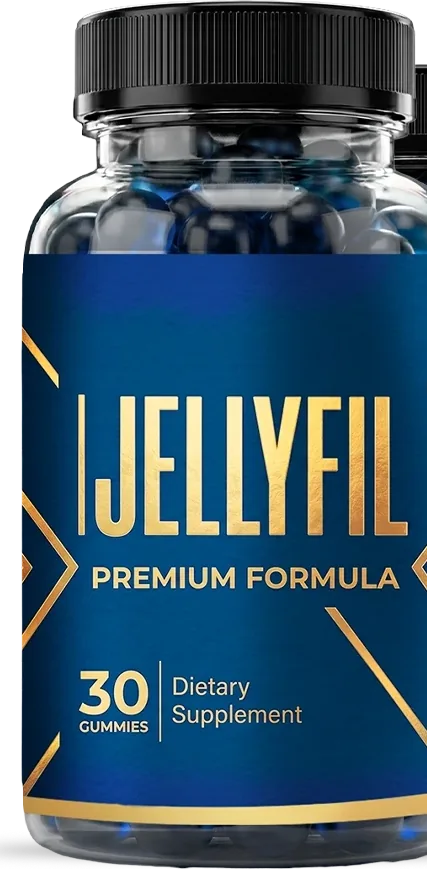
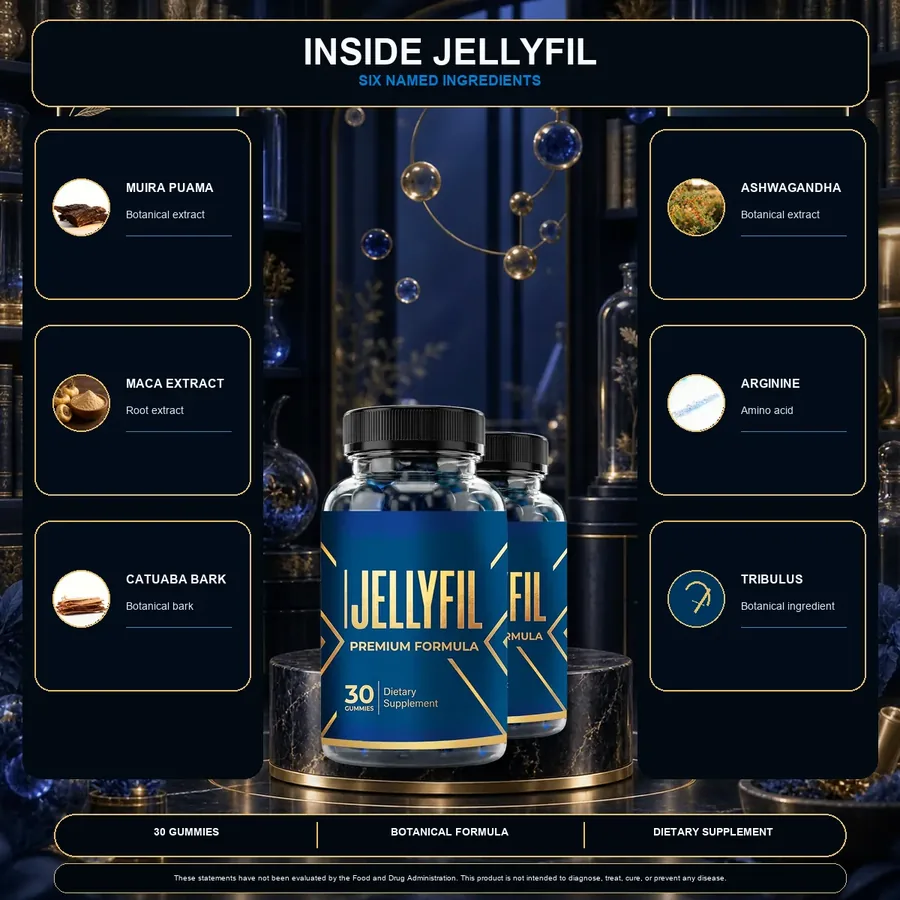
The printed panel names nine ingredients inside one 82 mg proprietary blend, in descending order by weight: muira puama, maca, catuaba, green tea extract, caffeine, ashwagandha, L-arginine, tribulus terrestris and horny goat weed extract. Only the caffeine has a published amount, at 5 mg. Three of the nine, green tea extract, caffeine and horny goat weed extract, do not appear on the sales page at all.
What are the nine names inside the blend?
Muira puama, maca, catuaba, green tea extract, caffeine, ashwagandha, L-arginine, tribulus terrestris and horny goat weed extract. All nine share a single proprietary blend of 82 mg, and only the caffeine carries its own figure.
The order matters more than most shoppers realise. A blend lists its ingredients in descending order by weight, so the sequence is a ranking even though the amounts are missing.
| Printed order | What it is | What it is studied for | Page or label | Amount published |
|---|---|---|---|---|
| 1. Muira Puama Extract | Amazonian bark and root | Traditional use, little controlled research | On both | Not published |
| 2. Maca Extract | Peruvian root, also a food crop | Sexual function, four small trials | On both | Not published |
| 3. Catuaba Extract | Brazilian bark, several plants share the name | Traditional use, almost no trials | On both | Not published |
| 4. Green Tea Extract | Leaf extract, a caffeine source | Widely studied, rare liver injury at high doses | Label only | Not published |
| 5. Caffeine | A stimulant with its own figure | Alertness, far above this amount | Label only | 5 mg |
| 6. Ashwagandha | Root of Withania somnifera | Sleep and stress, with safety notes | On both | Not published |
| 7. L-Arginine | An amino acid | Erectile function and exercise, at gram doses | On both | Not published |
| 8. Tribulus Terrestris | Puncture vine | Tested for testosterone, found not to influence it | On both | Not published |
| 9. Horny Goat Weed Extract | Epimedium, flavonoid icariin | Traditional tonic use | Label only | Not published |
The rest of this post takes those nine one at a time. Every entry ends the same way, and that repetition is the point.
The three traditional names
Muira puama, catuaba and horny goat weed are the oldest names on this list and the thinnest on evidence. A review of ingredients common in aphrodisiac products found the clinical evidence for most of them inadequate (Srivatsav and colleagues, 2020).
Muira puama extract
An Amazonian bark and root with a long reputation as a tonic. It sits first in the printed order, so it is the heaviest of the nine. Controlled human research on it is close to non-existent, so there is no standard amount to compare a label against even if a label gave one. No amount is published for it here.
Catuaba extract
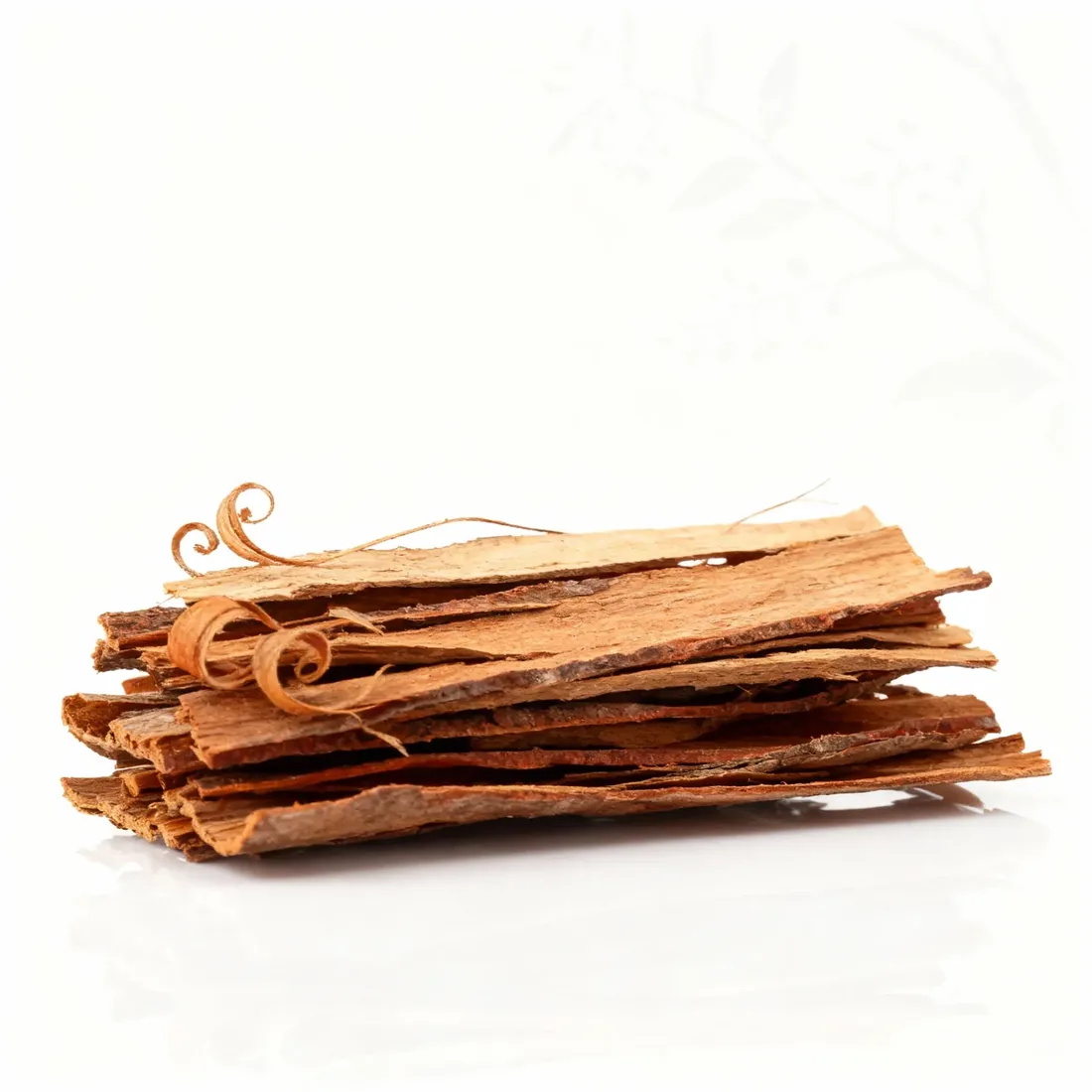
A Brazilian bark, third in the order. Catuaba is a market name rather than a single species, and several unrelated plants are sold under it, so a label saying catuaba has not yet said which plant. No amount is published for it here.
Horny goat weed extract
Epimedium, ninth and lightest of the nine. NIH's LiverTox describes it as a traditional tonic and aphrodisiac whose active flavonoid is icariin, and rates it unlikely to cause clinically apparent liver injury (LiverTox, NIH). That is a safety note, not an effect. No amount is published for it here.
The two that have been properly tested
Maca and tribulus are the two names here with randomized human data behind them, and the results point in different directions.
Maca extract
A Peruvian root eaten as a food crop as well as sold as a supplement, second in the order. A systematic review of four randomized trials found limited evidence for improved sexual function and said the trials were too few and too small for firm conclusions (Shin and colleagues, 2010). No amount is published for it here.
Tribulus terrestris
Puncture vine, eighth in the order, sold for decades on a testosterone story that has been tested directly. A controlled study in young men was titled, and concluded, that the aphrodisiac herb Tribulus terrestris does not influence androgen production (Neychev and Mitev, 2005). No amount is published for it here.
The two with the clearest safety notes
Ashwagandha and green tea extract are the two names here where the published literature is mostly about safety rather than effect.
Ashwagandha
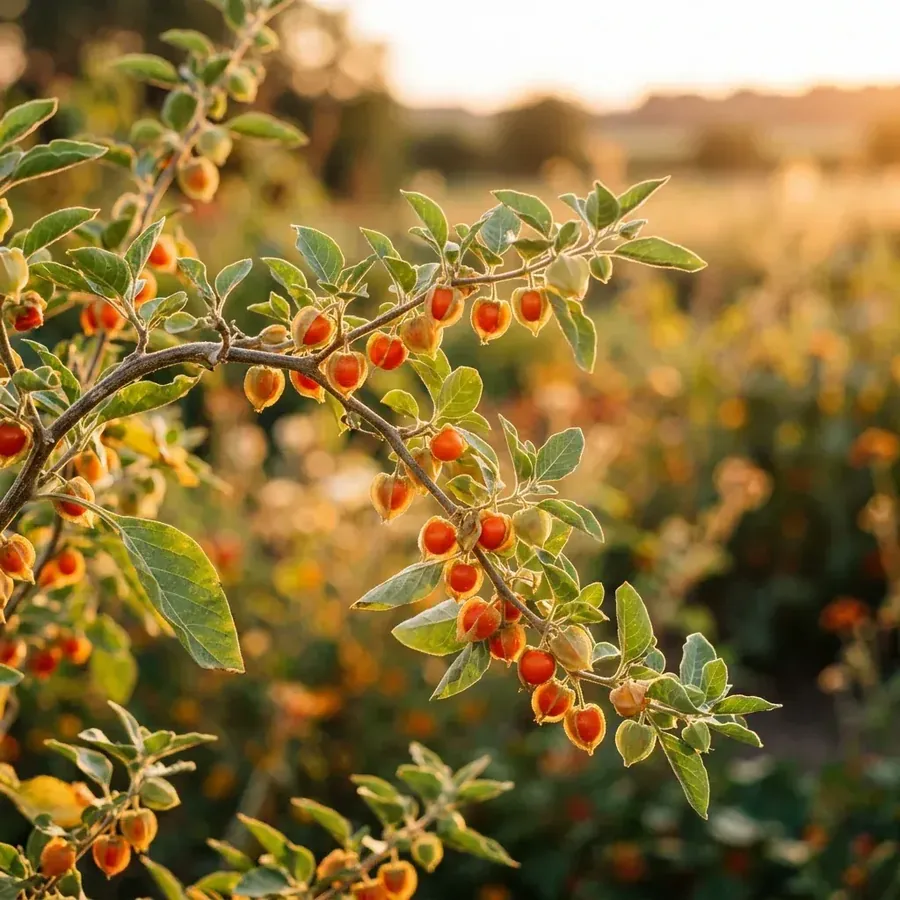
The root of Withania somnifera, sixth in the order and the most studied plant in the bottle. NCCIH says some preparations may help sleep and stress, that long-term safety is unknown, and that although rare, a number of cases have linked liver injury to ashwagandha supplements. It lists interactions with sedatives, thyroid, diabetes, blood pressure and immunosuppressant medicines, and advises avoiding it before surgery (NCCIH). No amount is published for it here.
Green tea extract
Fourth in the order, and one of the three the sales page never mentions. In supplements it usually arrives as a source of caffeine and catechins. High-dose green tea extract has been linked to rare cases of liver injury, which is why the missing figure is more interesting on this line than most (LiverTox, NIH). No amount is published for it here.
The amino acid and the stimulant
L-arginine and caffeine are the two ingredients here that are not plant extracts, and between them they carry the only published number.
L-arginine
An amino acid, seventh in the order. It is the one ingredient in this category with reproducible human results, which is why the amount matters more here than anywhere else on the panel (Srivatsav and colleagues, 2020). NIH's Office of Dietary Supplements notes doses of 2 to 20 grams a day in the performance research (NIH ODS). Two grams is 2,000 mg, and the entire blend weighs 82 mg. No amount is published for it here.
Caffeine
Fifth in the order, and the exception to everything above: the panel prints it at 5 mg. For scale, the FDA points to 400 mg a day as the level not generally associated with problems in healthy adults, and a cup of brewed coffee is roughly 95 mg (FDA). Five milligrams is about a twentieth of a cup. It is a real published amount, and it is a very small one.
Which three are on the label but not the sales page?
Green tea extract, caffeine and horny goat weed extract. The sales page names six ingredients and its marketing panel calls the product a 6-in-1 advanced daily formula. The printed panel names nine.
- Green tea extract, which is a caffeine source and has its own safety literature at high doses.
- Caffeine at 5 mg, which is the one ingredient on the whole panel with a published amount.
- Horny goat weed extract, which is a well-known name in this category and an odd one to leave out.
Where the two disagree, the printed label is the document that counts, so this site works from nine. Neither gap makes the gummy dangerous, and none of it is hidden: it is all on the back of the bottle. What it changes is what somebody thinks they are buying.
For the labeling rule that allows this, read proprietary blends explained. For the scale of the total, read what 82 mg buys you. For the panel itself, typed out line for line, read the Supplement Facts page, and for cautions and medicine interactions read side effects.
Questions people ask about this
How many ingredients does Jellyfil actually contain?
Nine are named inside the proprietary blend on the printed panel. The sales page names six and calls it a 6-in-1 formula. The label is the document that counts.
Which three does the sales page leave out?
Green tea extract, caffeine at 5 mg, and horny goat weed extract. All three are printed on the panel.
Does the printed order tell me how much of each there is?
No. It ranks them heaviest to lightest and nothing more. First is heavier than ninth, and the label never says by how much.
Which ingredient has the strongest human evidence?
L-arginine. A review of common aphrodisiac ingredients called it the only one showing reproducible improvement in human trials, and that research uses 2 to 20 grams a day.
Is 5 mg of caffeine enough to notice?
It is roughly a twentieth of a cup of coffee. The FDA points to 400 mg a day as the level not generally tied to problems in healthy adults.
Should ashwagandha worry me?
It has the longest safety note on this list: rare reports of liver injury, and interactions with sedatives, thyroid, diabetes, blood pressure and immunosuppressant medicines. If you take any of those, ask your doctor before starting.
Sources for this page
- Srivatsav A, Balasubramanian A, Pathak UI, et al. Efficacy and Safety of Common Ingredients in Aphrodisiacs Used for Erectile Dysfunction: A Review. Sexual Medicine Reviews, 2020. Source
- Shin BC, Lee MS, Yang EJ, Lim HS, Ernst E. Maca (L. meyenii) for improving sexual function: a systematic review. BMC Complementary and Alternative Medicine, 2010. Source
- Neychev VK, Mitev VI. The aphrodisiac herb Tribulus terrestris does not influence the androgen production in young men. Journal of Ethnopharmacology, 2005. Source
- National Center for Complementary and Integrative Health. Ashwagandha: Usefulness and Safety. Source
- LiverTox: Clinical and Research Information on Drug-Induced Liver Injury. Green Tea. National Institute of Diabetes and Digestive and Kidney Diseases. Source
- LiverTox: Clinical and Research Information on Drug-Induced Liver Injury. Horny Goat Weed. National Institute of Diabetes and Digestive and Kidney Diseases. Source
- NIH Office of Dietary Supplements. Dietary Supplements for Exercise and Athletic Performance: Fact Sheet for Health Professionals. Source
- U.S. Food and Drug Administration. Spilling the Beans: How Much Caffeine is Too Much? Source
Keep reading
Ready when you are
Order Jellyfil from the U.S. retail desk
One gummy a day. Follow the label on your bottle. 60-day money-back guarantee. A real person at +1 (507) 448-8190 for orders, tracking and refunds.